
Which Sandy Records Are Open?
Utah's Government Records Access and Management Act, known as GRAMA, starts from a right to inspect public material. It also places government-held information into public, private, controlled, and protected classes. That distinction matters for Sandy public records. A recorded deed and a parcel valuation are broadly open, while a recent birth certificate, juvenile case, or protected address is not an open name-search result. The custodian, not the subject matter alone, controls the route.
| Sandy record trail | Office responsible | Web coverage | How access works |
|---|---|---|---|
| Deeds, liens, and plats | Salt Lake County Recorder | Online to March 1, 1941 benchmark | Quick list free; images and deep data paid |
| Owner, parcel, and value | County Assessor and Treasurer | Current owner, address, or parcel search | Free web search; office fallback |
| District and justice cases | Utah Courts | XChange, with court-specific conversion dates | Paid web search; free terminals at most district courthouses |
| Marriage licenses | County Clerk and Archives | Historical index for 1887 to 1904 | Archives holds 1887 to 1944; Clerk holds 1945 forward |
| Vital certificates | Utah DHHS and local health departments | Historical indexes only | Recent copies require eligibility, ID, and a fee |
| Municipal files | Sandy City departments | Published material is spread across city pages | Department contact or city GRAMA request |
Sealed and expunged cases, juvenile and adoption material, recent vital certificates, sensitive family filings, restricted voter fields, and protected addresses remain outside ordinary access. Motor-vehicle data is limited by federal law. A public docket can still omit private documents, and a public parcel record does not prove that its owner lives at the situs address.
Note: Sandy is not the county seat, so county counters and archives are in Salt Lake City rather than Sandy City Hall.
Sandy Land Records Past 1941
Salt Lake County Recorder Data Services uses an exact online benchmark: Book 262, page 1, entry 899028, recorded March 1, 1941. Older vault material is being digitized toward 1850. That unusually precise marker is useful. A web search that stops before the benchmark calls for the Recorder's vault, not a conclusion that the instrument never existed.
The free property search confirms whether public records are tied to an address or parcel. A $5 temporary pass unlocks up to 150 units for 24 hours and can expose images, legal descriptions, parcel history, tract index, chain of title, maps, and plats. A search or abstract generally uses one unit, each document page one unit, and a plat or map page 20 units. Package units do not expire. Purchases are nonrefundable and nontransferable.
Use the free list to capture entry numbers before opening paid pages. New instruments recorded before 2 p.m. are generally online the next working day, though subdivision plats can take longer. In person, the Recorder's vault supplies the fallback for early material. Ordinary copies cost $2 per page, vault copies $5 per page, and certification adds $5 to the regular $2-per-page charge.
Sandy Parcel Records Search Keys
The county's free property valuation search is the open route to current assessment data. It can begin with a Sandy owner name, street address, or parcel number. The parcel number is the strongest cross-office key because it carries into Recorder, Treasurer, and county GIS systems even when street text differs.
| Form label | Input | Required | Format or use |
|---|---|---|---|
| Owner | Text | No | Last Name, First Name |
| Address | Autocomplete | No | Select a matching street address |
| Or Parcel Number | Text | No | 00-00-000-000-0000 |
| Search | Button | Yes | Runs the selected query |
Assessor results support owner, parcel, situs, value, assessment, legal description, acreage, exemption, property characteristics, and tax district research. The current result screen was not sampled, so any owner mailing address should be treated as conditional if displayed. A valuation record is not the deed, and the county GIS map is not a certified survey.
Sandy Court Records on XChange
Utah's XChange coverage table documents Sandy Justice Court data from July 20, 1998 and conversion of closed data to West Jordan District Court in June 2005. This is a records-geography quirk: an older Sandy matter may appear under a later court custodian. Sealed, expunged, and juvenile matters are excluded.
Search controls include jurisdiction, all-cases or judgments mode, case number, last or company name, first name, case type, statewide or local scope, birth date in some criminal searches, citation data, and date range. An asterisk wildcard is supported. Results can show court, county, case type and number, filing date, party name and role, history, document links, and page counts. The result cap is 500.
- Online guest access begins with $10 credit and charges $0.35 per search and $1 per document.
- Most district courthouses and the Utah State Law Library offer free XChange terminals.
- After finding the case number, request a named filing from the clerk in electronic, paper, audio, or certified form.
- Older files can move to Utah State Archives or Salt Lake County Archives, where indexes and case files may be separate series.
A case number is not unique across Utah. Keep the court, county, and number together. A name appearing as a party also does not establish wrongdoing or prove identity without another matching fact. Federal District of Utah cases use the separate PACER service.
Note: XChange charges for each search click, so narrow the court, date, and case type before submitting a broad name query.
Sandy Vital Records by Era
Vital access depends on both record type and age. Utah DHHS holds births and deaths from 1905 forward, plus marriage and divorce abstracts for 1978 through 2010 with limited later marriage data. Births become public after 100 years, deaths after 50 years, and marriage or divorce records after 75 years. Recent certified copies are limited to the subject, qualifying relatives, guardians, and legal representatives with identification and proof when required.
Salt Lake County Archives supplies the older Sandy route. Its marriage search covers 1887 through 1904, while archive custody extends through 1944. The County Clerk handles licenses from 1945 forward. Full divorce files belong with Third District Court, not the state abstract office. Before 1887, county marriage registration was not required, making church and newspaper sources important fallbacks.
Sandy Vital Application Routes
A qualified applicant may order through the official online service, apply at a participating local health department, or mail the form with identification, proof of relationship when needed, and payment. Mail goes to Vital Records, PO Box 141012, Salt Lake City, UT 84114-1012, and the state advises allowing at least six weeks. Questions can go to 801-538-6105 or vrequest@utah.gov. A search fee is not refunded when no certificate is found.
The official Utah vital-record application page shows the certificate routes and forms available to a qualified applicant.
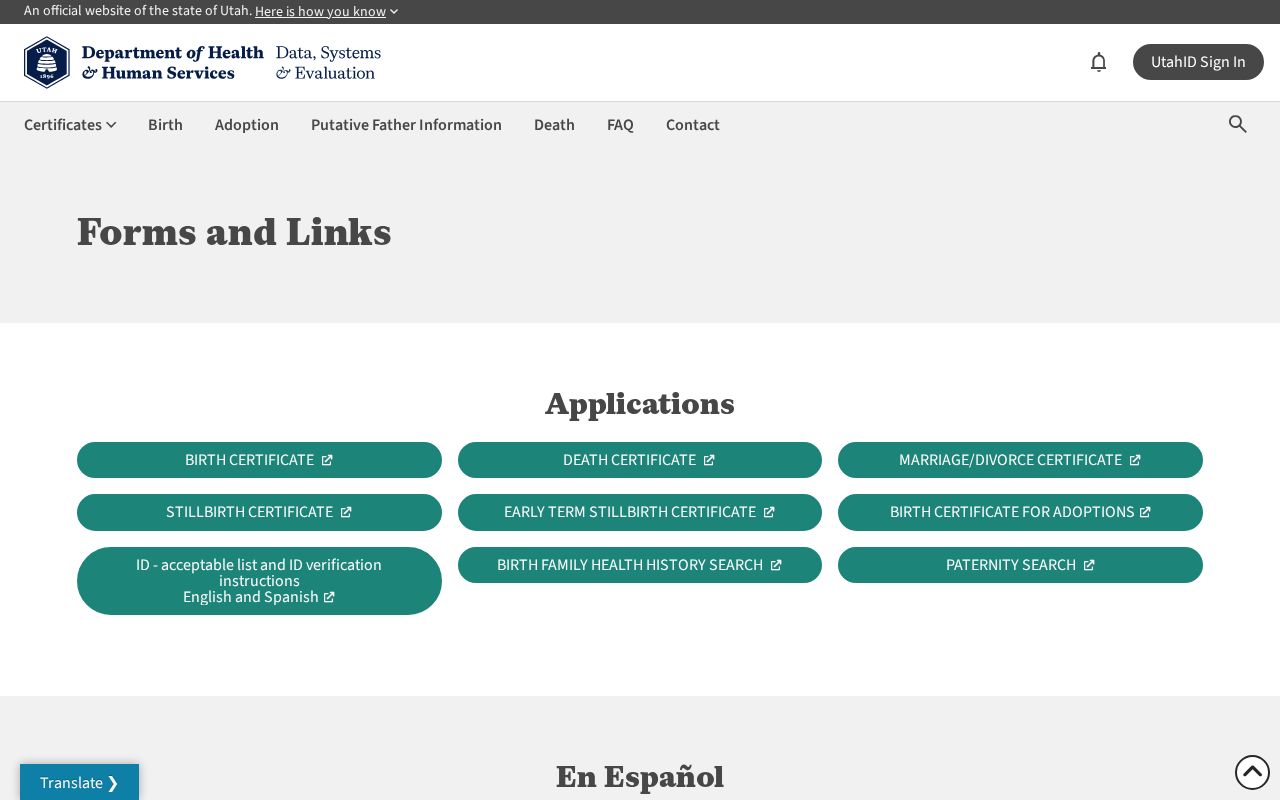
The application route is for a certificate or state abstract, while Archives and the court serve different historical and full-file needs.
Check the current fee page. The July 1, 2026 schedule lists $25 for birth, $35 for death, and $25 for a marriage or divorce abstract. Some recent PDF forms still show older amounts.
Sandy Public Records Office Routes
A Sandy request succeeds faster when it reaches the office that created or retains the file. The city Recorder coordinates city records, but it is not the land recorder. Deeds go to the county. Court files follow judicial rules rather than the city or county GRAMA portals. These contacts cover the main counter, telephone, and online alternatives.
Sandy City Recorder
10000 Centennial Parkway
Sandy, UT 84070
801-568-7100
City Recorder information
City Hall contact for municipal files
Salt Lake County Recorder
2001 S State St., Suite N1-600
Salt Lake City, UT
385-468-8145
Weekdays 8 a.m. to 5 p.m.
Recorder Data Services
Salt Lake County Archives
Permanent county and family-history records
385-468-0820
Archives custody guide
Call for series and access help
The County Clerk marriage division is reached at 385-468-7300. Recorder questions can also go to RecorderQ@saltlakecounty.gov; Data Services help uses RE-DataServices@saltlakecounty.gov. For court copies, first identify the court and case number through XChange, then use the Utah court-record request process.
Sandy City Records Beyond Portals
Sandy publishes some ordinances, resolutions, council material, business-license lists, permit guidance, cemetery resources, and staff contacts. Unpublished municipal files remain with the creating department, coordinated by the City Recorder. A request for deeds sent to City Hall will be redirected because county government keeps the land index.
For permits, the verified human fallback is Building & Code Compliance at 801-568-7251, City Hall Room 210, weekdays from 8 a.m. to 5 p.m. Ask for a defined address, date span, permit number, applicant or contractor, issue and final dates, and inspection status. Code files can contain complainant, inspection, legal, or active-investigation material that is withheld or redacted record by record.
The Sandy GRAMA request entry point provides the municipal written-request route.
The city request page is the fallback when a specific Sandy administrative record is not already published or available from its department.
Note: Sandy police reports use the separate Police Records Division and police GRAMA channel, with release based on each file's classification.
Sandy County Records Request Portal
Salt Lake County GRAMA guidance covers records retained by county departments. This channel is distinct from Sandy City's form and from judicial requests. It is appropriate when a county record is not exposed through Recorder, Assessor, Treasurer, Clerk, or Archives tools. Name the department, series, person, parcel, entry, license, or date range instead of asking for every item tied to one name.
The county's online request portal accepts and tracks county submissions.
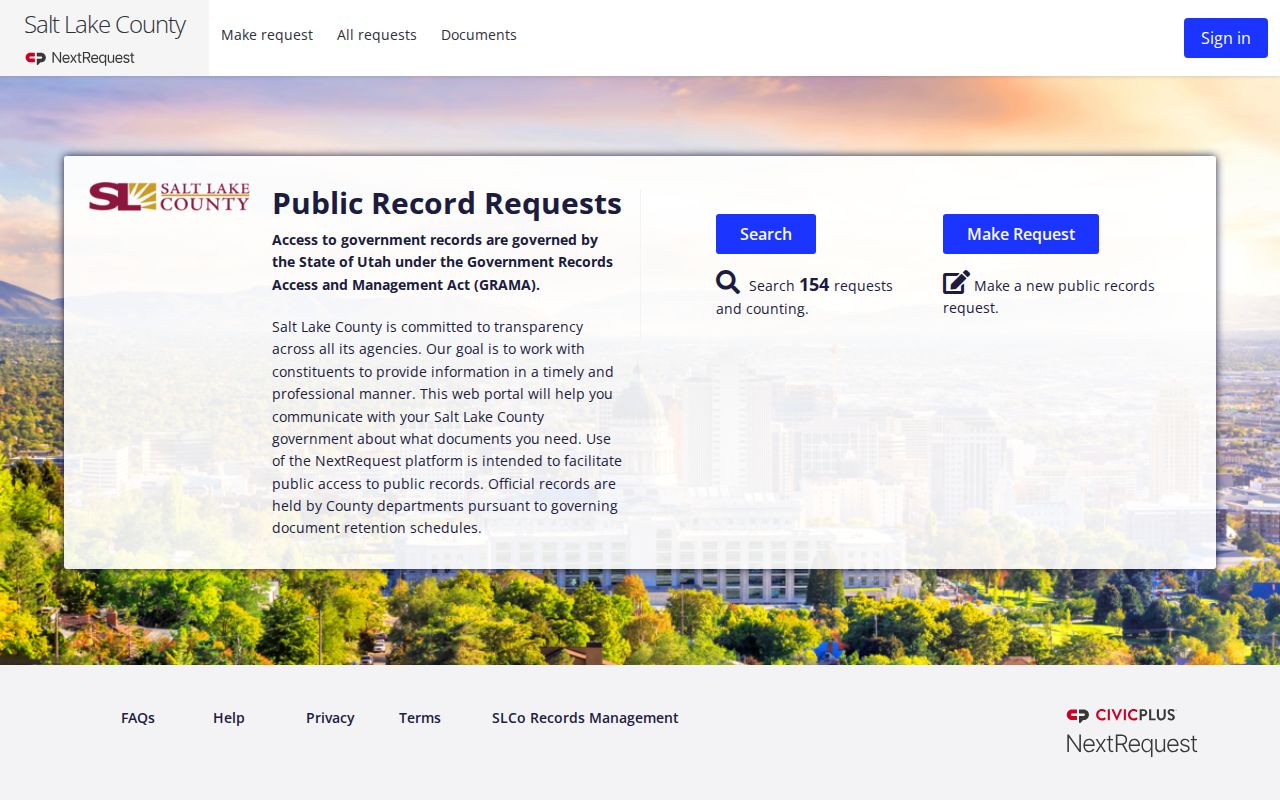
This portal handles county public records requests for administrative files. Recorder copies, court filings, and state vital certificates still follow their dedicated access channels and fee schedules.
Sandy Police and Custody Records
Sandy police material does not have a verified public person-name index. Use the Police Records Division or police GRAMA route with the report number, incident date and time, location, involved person, and requester relationship. Victim data, juvenile material, open-investigation evidence, and safety-sensitive details may be withheld or redacted. The Sandy non-emergency number is 801-568-7200.
The Utah Department of Corrections Offender Search is a different system. It covers current incarceration, probation, and parole under state supervision. It does not include unsentenced county detainees. Search by offender number or by first and last name, with an optional middle name. Utah VINE, available at 1-877-884-8463, supplies status notifications rather than a historical case file.
No current official Salt Lake County jail-roster URL or exact Utah offender-registry portal was verified in the research. Those gaps should be handled by calling the responsible agency rather than relying on an unofficial copy.
Sandy Records Access Terms
The choice between an index, a plain image, and a certified copy can change both cost and usefulness. A quick index may be enough to verify that a Sandy document exists. A full image carries the instrument text. Certification is needed only when a receiving institution requires the custodian to attest to the copy.
- Custodian
- The government office that retains and responds for a record.
- Index
- A finding tool with identifying details, not the full filed document.
- Certified copy
- A reproduction formally authenticated by the office that holds it.
- Exemption
- A legal basis for withholding all or part of an otherwise responsive record.
- Situs
- The property's physical location, which can differ from a mailing address.
Ask the recipient what form it needs before ordering. For family research or civic review, an index, docket history, or plain image can be cheaper and more informative than certification.
Utah Safe at Home can provide an eligible person and household with a substitute address, while voter At-Risk protection is a separate election-record process. Neither program erases an older deed or directory entry. The Utah Consumer Privacy Act gives qualifying consumers rights against covered businesses, but it does not delete government files that remain public by law.
Sandy GRAMA Time and Appeals
Utah Code Title 63G, Chapter 2 requires a response as soon as reasonably possible and no later than ten business days for an ordinary request. A qualifying public-benefit expedited request uses five business days. An entity may provide the records, deny access with a cited classification and appeal instructions, identify another likely custodian, or explain extraordinary circumstances.
Reasonable actual costs can be charged under section 63G-2-203. The first quarter-hour is ordinarily free, subject to the 2025 repeat-request exception. Prepayment can be required when estimated fees exceed $50 or prior invoices remain unpaid. Waiver factors include public benefit, a requester seeking their own record, and certain legal-rights needs.
A denial first goes to the chief administrative officer. Further review can proceed through the Government Records Office or State Records Committee route, or district court. A narrow request can also resolve a dispute faster by identifying the series, date span, subject, and desired format.
Request Sandy Public Records Precisely
A written GRAMA request needs the requester's name, mailing address, a willing email address, daytime telephone number, and a reasonably specific description. Adding the agency, record series, person, address, case or parcel number, and date range helps Sandy or Salt Lake County locate the right file. State whether inspection, electronic delivery, a plain copy, or certification is needed.
- Identify the retaining office. Separate Sandy municipal files from county land, tax, marriage, archive, court, and state records.
- Check the dedicated index. Capture a parcel, entry, case, license, or event number before requesting a document.
- Describe the record. Give names, addresses, dates, series, and a clear range. Ask for an estimate or set a fee cap if needed.
- Choose the format. Request inspection, an electronic file, a plain copy, or certification based on the actual need.
- Review the response. Pay valid costs, narrow an overbroad request, or follow the cited appeal path after a denial.
Lawful personal use. Open records can support genealogy, property questions, reconnecting, and civic oversight. Do not use Sandy records to stalk, harass, threaten, or harm anyone.
Note: A portal's cutoff describes converted online data, not every record still held at a counter, vault, court, or archive.